Why Business Owners Who Share Struggles Get More Referrals Than Those Who Hide Them
You’re tired of networking that feels like performing.
Every week, the same polished pitches. The same highlight reels. Everyone’s business is “crushing it” and “scaling fast.” Nobody admits they lost a client, made a mistake, or struggled with anything real.
And you walk away thinking: “If everyone’s doing so great, why do I feel like I’m the only one who needs referrals?”
Here’s the truth traditional networking doesn’t tell you: The business owner who admits “I lost a big client this week” gets more referrals than the one bragging about constant wins.
Sounds backwards? Science says it’s not. Controlled vulnerability builds trust faster than perfection ever could.
And you’re about to discover why and how to use it without oversharing.

Sarah Martinez
Marketing Consultant
Martinez Marketing Solutions
Vancouver, BC
"I used to hide my struggles and wonder why no one referred me. Now I share real challenges in my videos and group members actively want to help."
Fictional character for illustrative purposes
When Sarah Martinez records her weekly video and mentions she’s struggling to find the right project management software, three group members message her with recommendations within hours. When she shares that a marketing campaign underperformed, two members offer to review her strategy. When she admits she’s overwhelmed juggling client work and business development, the group rallies with referrals to ease her pipeline stress.
Sarah isn’t weak. She’s strategic. She understands what psychologists call the self-disclosure effect the research-backed principle that sharing personal information creates deeper trust than maintaining a professional facade.
And in business networking? Vulnerability isn’t just authentic. It’s a competitive advantage.
What Is Self-Disclosure (And Why It Works)
Self-disclosure is the voluntary sharing of personal thoughts, feelings, and experiences. In psychology, it’s one of the most powerful trust-building mechanisms available.
Here’s how it works: when you reveal something personal a challenge you’re facing, a mistake you made, a fear you have you signal trust in the other person. You’re saying, “I believe you’re safe enough to hear this.”
That signal triggers reciprocity. The listener thinks, “If they’re willing to be real with me, I should be real with them.” Trust begets trust.
A 2022 study published in Frontiers in Psychology analyzed social media creators and found that those who shared personal stories, challenges, and struggles generated significantly higher trust and connection with audiences than creators who maintained professional distance. The vulnerability admitting imperfection was the single strongest predictor of audience loyalty.
For business networking, this changes everything.
The Traditional Networking Script: Perfection Theater
Walk into a typical networking event. What do you hear?
“Business is booming.”
“We just closed our biggest quarter ever.”
“We’re expanding into three new markets.”
“Our client retention rate is ninety-eight percent.”
Everyone’s crushing it. Everyone’s winning. Everyone sounds like a case study from a business school textbook.
And everyone sounds… exactly the same. Polished. Generic. Distant. You walk away with a stack of business cards but no real sense of who these people are. They’re professional masks, not real humans.
Worse, the perfection arms race creates skepticism. When everyone claims constant success, trust actually decreases. “Are they exaggerating? Hiding problems? Do they even need my referrals if they’re doing so well?”
The polished pitch builds walls, not bridges.
The Vulnerability Alternative: Real Business Reality
Now imagine Sarah’s video update:
“Hey everyone. Quick update from my week. I launched the new service package I mentioned last time got two inquiries already, which is exciting. But I also had a client project go sideways because of miscommunication on deliverable timelines. Totally my fault for not clarifying expectations up front. Lesson learned now I’m building a better onboarding checklist to prevent that. Also, if anyone has recommendations for project management tools that handle recurring tasks well, I’d love to hear them. Current system isn’t cutting it. Okay, that’s my week looking forward to hearing yours!”
What just happened?
Sarah shared a win (new service launch, two inquiries), a struggle (project miscommunication), a lesson learned (better onboarding process), and a specific ask (project management tool recommendations). She’s competent but not perfect. Professional but real. Confident enough to admit mistakes.
Your brain registers three things instantly:
- Authenticity - Only genuine people admit mistakes; constant perfection means something’s being hidden
- Relatability - “She struggles with the same project management chaos I do”
- Safety - “If she’s willing to be vulnerable, I can be too”
That’s how trust forms. Not over months of careful relationship-building. In 60 seconds of honest communication.
Why Vulnerability Signals Credibility
Here’s the paradox: admitting weakness makes you appear stronger.
Elliot Aronson’s 1966 research on the pratfall effect demonstrated this counterintuitive principle. Competent people who made small mistakes were rated as more likable and trustworthy than equally competent people who appeared flawless. The stumble humanized them.
Why does admitting weakness make you appear stronger?
1. Authenticity Filter
Your brain has a finely tuned detector for fakeness. When someone projects constant perfection, your skepticism activates: “What are they hiding? Everyone has bad weeks. Why aren’t they admitting it?”
Perfection feels like performance. Marketing. A sales pitch. Your guard stays up.
But when someone admits a real challenge “I lost a client,” “I made a hiring mistake,” “I’m struggling with cash flow” your brain registers: “That’s honest. Only a real person admits that.”
Vulnerability passes the authenticity test immediately.
2. Similarity and Connection
Research shows that perceived similarity is one of the strongest predictors of trust. We trust people who are like us.

Miguel Rodriguez
General Contractor
Heritage Home Builders
Surrey, BC
"Finding reliable subcontractors stresses me out. Every contractor in my group nodded instant connection through shared struggle."
Fictional character for illustrative purposes

Linda Morales
Mortgage Broker
Morales Home Loans
Richmond, BC
"I lost a deal to a rate-shopper. Other brokers related immediately common ground established through shared frustration."
Fictional character for illustrative purposes
When Miguel Rodriguez shares in his video that he’s stressed about finding reliable subcontractors, every contractor in his group thinks: “Same. That’s my biggest headache too.” Instant connection through shared struggle.
When Linda Morales admits she lost a mortgage deal because a competitor offered a lower rate, other brokers relate: “Been there. Price-shoppers are frustrating.” Common ground established.
Perfection creates distance. “Their business is nothing like mine they’ve got it all figured out.”
Vulnerability creates similarity. “We’re facing the same challenges. They get it.”
And similarity builds trust.
3. Reciprocity: Your Vulnerability Invites Mine
Self-disclosure triggers reciprocal disclosure. When you share something personal, the listener feels compelled to match your vulnerability.
This is why therapy works the therapist creates a safe space, and the client opens up. It’s why close friendships form through mutual vulnerability. And it’s why business relationships deepen when both parties move past surface-level small talk.

Tom Marino
Accountant (CPA)
Marino & Associates Accounting
Coquitlam, BC
"When Sarah admitted she's overwhelmed, I responded in my video: 'Same here tax season always crushes me.' Reciprocal vulnerability deepened our trust."
Fictional character for illustrative purposes
In video networking, this plays out powerfully. Sarah admits she’s overwhelmed with client work. Tom Marino responds in his video: “I hear you, Sarah same here. Tax season always crushes me.” Now both have shared something real. Trust deepens.
Within weeks, the entire group has established a culture of honest communication. No one’s pretending to be perfect. Everyone’s sharing real challenges and real wins. The network becomes a support system, not a performance stage.
4. Humanization: From Corporate Facade to Real Person
Let’s be honest: “Martinez Marketing Solutions” sounds like a corporation, even though it’s just Sarah working from her home office.
But when Sarah shares a video where her cat walks across her keyboard mid-recording, or she mentions her kid’s soccer game, or she admits she’s tired from a rough night suddenly Martinez Marketing Solutions isn’t a faceless entity. It’s Sarah. A real person with a real life.
That humanization matters for referrals. People refer people, not businesses. When you know Sarah as a human not just a logo you think of her when opportunities arise. “Oh, my neighbor needs marketing help. I should connect them with Sarah. She’s great.”
Vulnerability transforms abstract service providers into real humans you actually care about.
The Optimal Vulnerability Zone: What to Share (and What to Avoid)
Here’s the critical nuance: controlled vulnerability builds trust. Uncontrolled oversharing destroys it.
Not all disclosure is equal. There’s a sweet spot between distant professionalism and TMI (too much information).
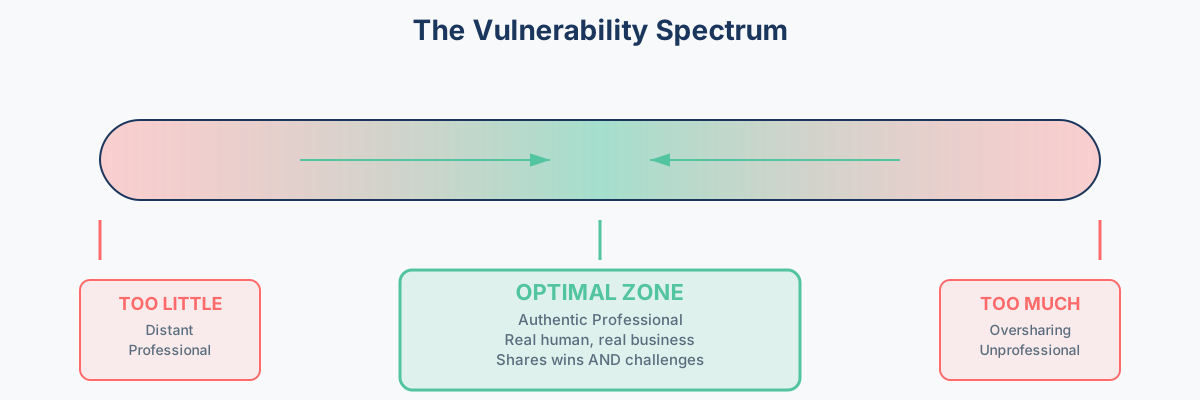
The Vulnerability Spectrum
Zone 1: Too Little (Distant Professional)
- Only share wins and successes
- No personal details
- No struggles or challenges
- Corporate, impersonal tone
Result: Trust stays surface-level. You remain a stranger.
Zone 2: Optimal Vulnerability (Authentic Professional)
- Share wins AND challenges
- Personal but professional
- Genuine but boundaries intact
- Real human, real business
Result: Trust accelerates. Connection deepens.
Zone 3: Too Much (Oversharing Unprofessional)
- Complain excessively
- Share inappropriate personal drama
- Financial desperation
- Violate others’ privacy
Result: Trust collapses. Credibility damaged.
What TO Share (Builds Trust)
Business Challenges You Overcame
- “I struggled with pricing strategy this quarter here’s what finally clicked”
- “Lost a client to a competitor. Learned I need to communicate value better”
- “Hiring is brutal right now. Anyone else finding it hard to find quality candidates?”
Personal Excitement or Milestones
- “Family vacation next week finally taking time off after a crazy six months”
- “My kid just got accepted to college proud parent moment”
- “Launched a new website and I’m genuinely excited about it”
Mistakes You Made and Learned From
- “I underestimated project scope and had to eat costs. Won’t make that mistake again”
- “Missed a deadline because I didn’t set calendar reminders. New system in place now”
- “Said yes to a bad-fit client. Red flags were there I ignored them”
Client Success Stories (With Permission)
- “Helped a client triple their email open rates here’s what we did”
- “Client just hit their revenue goal six months early. Feels good to see them succeed”
- “Worked with a struggling startup that’s now profitable. Love these wins”
Industry Trends You’re Navigating
- “AI tools are changing how I approach content strategy anyone else experimenting?”
- “Interest rates are affecting my real estate clients. Adjusting my approach”
- “Supply chain delays are brutal this year. How are other contractors handling it?”
What NOT to Share (Destroys Trust)
Confidential Client Information
- Never share client names, financial details, or private information without explicit permission
- Even “anonymous” stories can violate trust if details are identifiable
Complaints About Specific People
- Don’t badmouth competitors, difficult clients, or former employees by name
- General industry frustrations are fine; personal attacks are not
Overly Personal Drama
- Relationship problems, health crises, family conflicts these cross professional boundaries
- Keep it professional: “Dealing with some personal stuff this week, so I’m a bit behind” is fine. Details aren’t necessary.
Financial Desperation
- “I need clients or I can’t pay rent” signals risk, not opportunity
- Honest challenges (“slower month than expected”) are fine. Desperation isn’t.
Anything You Wouldn’t Want a Potential Client to See
- Remember: your group members might share your videos with referrals
- Stay professional enough that you’d be comfortable with prospects seeing your updates
The Trust Acceleration Timeline
Here’s what vulnerability does to the trust-building timeline:
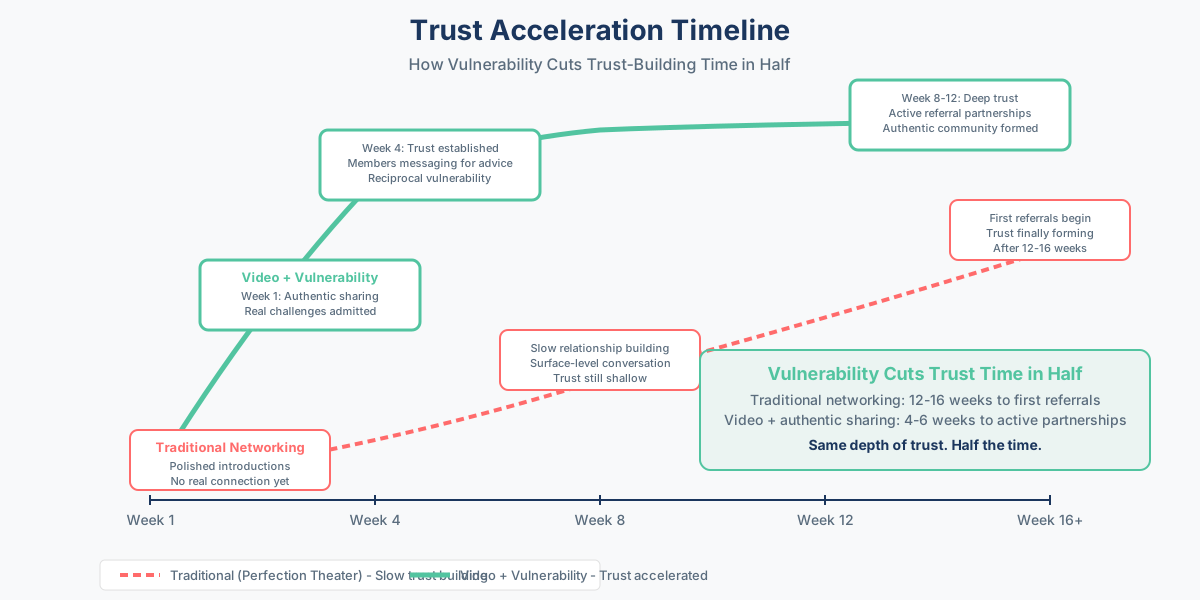
Traditional Networking (Perfection Theater)
- Week 1-4: Polished introductions, no real connection
- Week 5-8: Slow relationship building through surface-level conversation
- Week 9-12: Trust finally starts forming as people gradually open up
- Week 13+: First referrals begin, but trust is still shallow
Video Networking with Vulnerability
- Week 1: Sarah shares authentic intro with real challenge
- Week 2-3: Group reciprocates with their own vulnerabilities
- Week 4: Trust is already established members are messaging each other for advice
- Week 5-8: First referrals start flowing because everyone feels safe
- Week 9-12: Deep trust and active referral partnerships
The difference? Vulnerability cuts trust-building time in half.

Emma Thompson
Real Estate Agent
Thompson Realty Group
Burnaby, BC
"I admitted being new to real estate in my video. Instead of dismissal, Marcus offered mentorship. Age bias disappeared when honesty signaled teachability."
Fictional character for illustrative purposes
When Emma Thompson admits in her first video that she’s only been in real estate for five years and still learning market analysis, older realtors might’ve dismissed her. Instead, Marcus (a financial advisor in her group) messages: “I’ve got 15 years of real estate data experience. Happy to share what I’ve learned.”
By Week 3, Marcus is referring his clients to Emma because he’s watched her demonstrate genuine learning and client care in her videos. The age bias that would’ve blocked trust in traditional networking disappeared because Emma’s honesty signaled competence and teachability.
That’s the power of being real. Authentic relationships, faster.
Why This Works Better in Video Than Live Networking
Here’s the thing: vulnerability in live networking can backfire.
Stand up in front of 40 people at a Chamber event and say, “I’m struggling to find clients” you risk looking desperate. Admit in a meeting that you made a costly business mistake you might get judgment instead of support.
Live vulnerability requires perfect timing, audience awareness, and delivery. Too much pressure. Most people default to the safe, polished pitch.
But video changes everything.
Recording Alone Lowers the Stakes
When you record a video alone in your office, the pressure drops. No audience staring at you. No real-time reactions to manage. You can be honest without fear of immediate judgment.
If you stumble or overshare, you can re-record. You control the message.
This low-stakes environment encourages authentic communication. Sarah can admit she’s overwhelmed without worrying about awkward silence or pity looks. Tom can share a business mistake without feeling like he’s losing credibility in real-time.
Viewers Process on Their Own Terms
When someone watches your vulnerable video, they’re alone. No social pressure to react a certain way. They can absorb your message, reflect, and respond thoughtfully when ready.
This creates empathy instead of judgment. In a live setting, group dynamics can amplify negative reactions. When viewers watch alone, they process individually and often respond with support, not criticism.
Consistency Builds Safety
After 8-12 weeks of weekly videos where everyone shares both wins and struggles, the group culture shifts. Vulnerability becomes normalized. No one’s pretending to be perfect. Everyone’s being real.
That group norm creates safety. “If everyone else is being honest, I can be too.”
Within months, your network isn’t performing for each other you’re genuinely supporting each other. And that’s when referrals flow.
Real Example: David Park’s Breakthrough

David Park
Commercial Insurance Broker
Park Insurance Solutions
New Westminster, BC
"I was great at live networking confident, charismatic, always 'on.' But admitting a client loss in a video changed everything. Referrals tripled when I got real."
Fictional character for illustrative purposes
David Park (insurance agent in Langley, BC) was naturally charismatic in live networking. Big personality, confident pitch, always “on.” He’d been in BNI for three years and got steady referrals nothing extraordinary, but consistent.
When he joined Rhythm of Business, he kept the same energy for the first month. Polished videos, highlight wins, always upbeat.
Then in Week 5, he tried something different:
“Hey everyone. Tough week. Had a client cancel a large policy because they found cheaper coverage. Honestly, it stung I thought we had a solid relationship. Made me realize I’ve been focusing too much on closing deals and not enough on ongoing value communication. So I’m launching monthly check-ins with all my clients to stay top-of-mind and genuinely serve them better. If anyone has strategies for client retention beyond just annual renewals, I’m all ears. Anyway, that’s my week learning and adjusting.”
Within 24 hours, four group members messaged him:
- A financial advisor shared his client retention playbook
- A contractor offered to introduce David to his trusted insurance clients
- A realtor connected him with a new homeowner who needed coverage
- Linda (mortgage broker) said: “Appreciate the honesty, David. We all lose deals. I just lost three this month to rate-shoppers. Let’s grab coffee and commiserate.”
David’s referrals tripled over the next 60 days.
Why? Because vulnerability signaled that he was real. Not just a sales guy. A real business owner dealing with real challenges. Someone safe to refer clients to because he cared about improving, not just winning.
“Your struggles don’t make you weak. They make you relatable. Perfect pitches build walls. Honest challenges build bridges.”
But here’s the problem: most networking groups punish vulnerability instead of rewarding it.
Live meetings where everyone’s watching your reaction. Public shaming for “negativity.” Pressure to always project success or risk looking desperate.
You need a space where honesty is safe. Where admitting challenges doesn’t hurt your reputation it strengthens your referrals.
That’s exactly what we built.
How to Start: Your Next Video
If you’ve been projecting perfection in your networking, here’s how to shift toward strategic vulnerability:
1. Share One Challenge in Your Next Update
Pick something real but not catastrophic:
- “I’m struggling to balance client work with business development”
- “I underestimated a project timeline and had to work late to deliver”
- “I’m trying to improve my email response time currently overwhelmed”
2. Follow the Win-Struggle-Lesson Formula
Structure your updates: “Here’s what went well + Here’s what didn’t + Here’s what I learned”
Example: “Closed two new clients this week (win). But I also realized my onboarding process is disorganized one client was confused about next steps (struggle). So I built a welcome packet to streamline that going forward (lesson).”
3. Ask for Specific Help
Vulnerability plus a specific ask = powerful engagement.
“I’m looking for a better CRM that handles recurring tasks anyone have recommendations?”
“Trying to improve my client retention strategy what’s worked for you?”
“Struggling with pricing for this new service how do you approach pricing conversations?”
Specific asks invite reciprocal vulnerability. People love helping when you’re clear about what you need.
4. Watch Group Culture Shift
After 2-3 weeks of authentic sharing, notice how others start reciprocating. The masks come off. The network becomes real.
And when trust is real, referrals follow.
“You don’t need a perfect pitch. You need a safe space to be real. That’s how trust accelerates.”
The Bottom Line
You’ve been told networking requires perfection. It doesn’t. It requires authenticity.
But authenticity without safety is risky. Share struggles in the wrong environment and you’ll get judgment, not support.
Here’s what changes when you network in a space designed for vulnerability:
Faster trust - Weeks instead of months
Deeper relationships - Mutual support instead of transactional exchanges
Better referrals - People refer those they genuinely trust, not just those with good pitches
Stronger culture - Authentic community instead of networking theater
Real business growth - Genuine relationships generate genuine revenue
Sarah Martinez doesn’t project perfection in her videos. She shares wins and struggles. She asks for help. She admits mistakes. She’s real.
And she gets more referrals than she ever did performing in traditional networking.
You can too.
“Authenticity isn’t a risk when the environment rewards honesty instead of punishing it.”
Your Next Step
Discover how Rhythm of Business creates safe space for authentic networking.
Find Your Group
Get matched with local business owners who value honesty over perfection.
$69 CAD/month
no charge until matched · cancel anytime
Sources cited:
- Aronson, E., Willerman, B., & Floyd, J. (1966). The effect of a pratfall on increasing interpersonal attractiveness. Psychonomic Science, 4(6), 227-228.
- Jiang, S., & Ngien, A. (2022). Effects of Instagram-related activities on self-disclosure and social comparison. Frontiers in Psychology, 13, 1-12.
- Collins, N. L., & Miller, L. C. (1994). Self-disclosure and liking: A meta-analytic review. Psychological Bulletin, 116(3), 457-475.