From Strangers to Trusted Partners: The 12-Week Journey
Tired of networking events that waste your time? You spend 2 hours at a chamber mixer, collect business cards you’ll never use, and walk away with zero qualified referrals.
Meanwhile, your competitors are building trusted referral networks without the time-wasting meetings.
Let me tell you a story about Sarah and Tom, fictional characters from our novel Rhythm of Business Networking. She’s a marketing consultant. He’s an accountant. They’ve never spoken live. Never had a Zoom call. Never met for coffee.

Sarah Martinez
Marketing Consultant
Martinez Marketing Solutions
Vancouver, BC
15 years helping small businesses grow. Spent 3 years in traditional networking and got nowhere. Switched to video networking and built her dream referral network in 12 weeks.
Fictional character for illustrative purposes

Tom Marino
Accountant (CPA)
Marino & Associates Accounting
Coquitlam, BC
Tax specialist for small businesses. Skeptical about video at first: "Who has time for this?" By Week 5, he was hooked. By Week 12, his referral pipeline was overflowing.
Fictional character for illustrative purposes
In the story, over 12 weeks of watching each other’s 60-second videos, they went from complete strangers to trusted business partners. By Week 12, when Sarah proposed a partnership, Tom said yes immediately because he already knew her well enough to trust her.
This is what Rhythm of Business is built for. Weekly 60-second videos can turn into trusted referral relationships without mandatory meetings, without mixers, without cold outreach.
The pattern is a common one: Strangers become familiar faces. Familiar faces become trusted colleagues. Trusted colleagues become referral partners.
Here’s how it unfolds week by week.
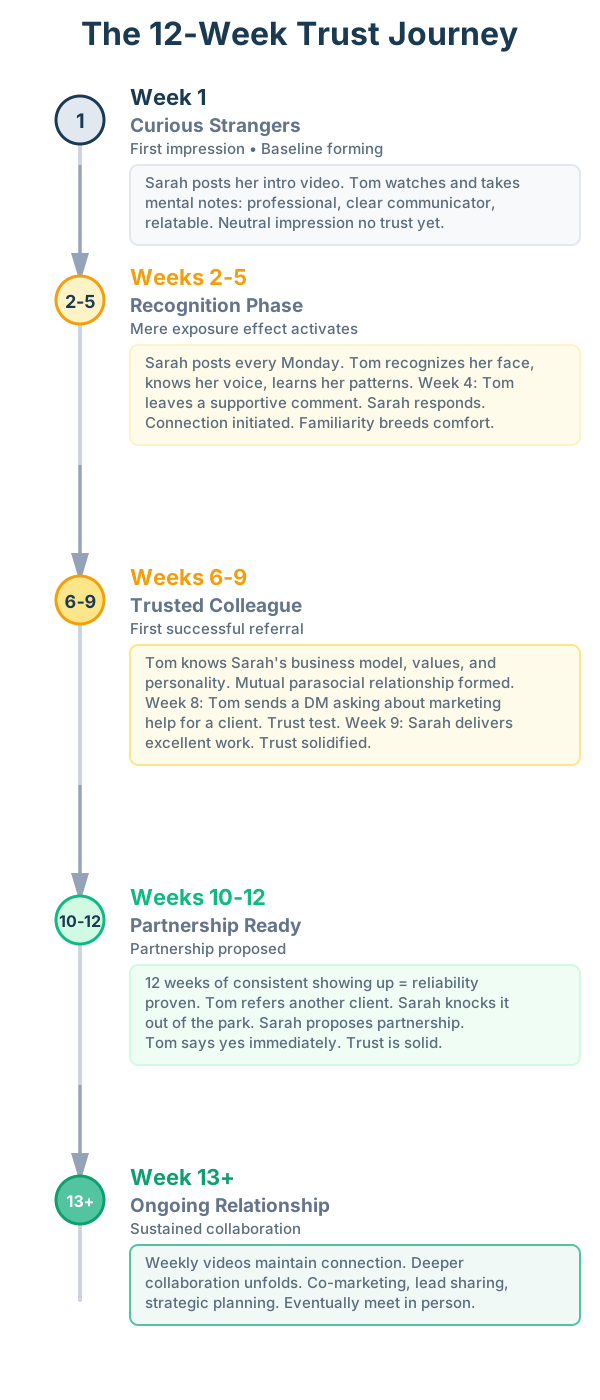
Week 1: Curious Strangers
Sarah’s first video goes live.
She introduces herself: marketing consultant, 15 years experience, passionate about helping small businesses grow. She talks about a recent client win. Nothing flashy, just genuine.
Tom watches.
He’s an accountant in the same networking group. Doesn’t know Sarah yet. But he’s taking mental notes:
- “She seems professional”
- “Clear communicator”
- “Relatable”
Tom has no reason to trust Sarah yet. But he’s not wary either. His brain files her as “new person” and starts forming a baseline.
This is just information gathering. No trust yet, but the foundation is being laid.
“Trust doesn’t start with a handshake. It starts with consistent showing up.”
Weeks 2-5: The Recognition Phase
Sarah posts every Monday. Tom watches every week.
Week 2: Sarah shares a lesson learned from a failed campaign. Tom appreciates the honesty.
Week 3: Sarah mentions a recent win. Tom leaves a congratulatory reply. Sarah responds with a genuine “thanks!”
Week 4: Tom realizes he’s looking forward to Sarah’s videos. Her face is familiar now. Her voice is comfortable. He knows her patterns: she always posts Mondays, talks about client projects, shares wins and losses honestly.
The mere exposure effect is kicking in. Tom sees Sarah’s face every week, and his brain registers her as familiar = safe.
The relationship is forming even though they’ve never interacted beyond that one reply.
“Familiarity doesn’t require face time. It requires face recognition.”
Weeks 6-9: Trusted Colleague Territory
By Week 6, Tom doesn’t just recognize Sarah. He knows her.
He knows her business model (retainer clients plus project work). He knows her values (transparency, client results over vanity metrics). He knows her personality (straight shooter, honest about failures).
And Sarah knows Tom too. She’s been watching his videos. She knows he specializes in small business taxes, hates last-minute filers, and loves talking tax strategy.
Week 7: Tom references Sarah’s past update in his own video.
“Sarah mentioned last week how she tracks campaign ROI. Smart approach. Reminds me of how we track deductions for clients.”
Sarah watches Tom’s video and feels seen. He’s been paying attention. That matters.
Week 8: Tom messages Sarah in the app.
“Hey Sarah, quick question: do you work with retail businesses? I have a client who might need marketing help.”
This is a trust test. Tom’s putting his reputation on the line by referring someone. If Sarah delivers, trust solidifies. If she fails, trust breaks.
Week 9: Sarah delivers excellent work for Tom’s referral.
The client is thrilled. Tom’s reputation is intact. Sarah just proved she’s reliable.
Trust is forming. Tom has 9 weeks of evidence: Sarah shows up consistently, communicates clearly, delivers quality work. He knows what to expect from her now.
Key moment: The first successful referral is the bridge from familiarity to trust.
“Trust isn’t given. It’s proven one consistent action at a time.”
Weeks 10-12: Partnership Readiness
Week 10: Tom refers another client to Sarah.
Bigger stakes this time. Larger project. Sarah delivers excellent work again.
Week 11: Sarah and Tom are messaging regularly.
Quick questions. Shared insights. Occasional “loved your video this week” notes. The relationship feels natural now: not forced, not transactional.
Week 12: Sarah proposes a partnership.
“Tom, I’ve been thinking. A lot of my clients need tax help, and your clients probably need marketing. Want to co-create a package? We could cross-promote and share leads.”
Tom doesn’t hesitate. “Yes. Let’s do it.”
Why? Because 12 weeks of consistent showing up equals reliability proven. Sarah’s not a stranger anymore. She’s a trusted colleague Tom would bet his reputation on.
The partnership proposal feels natural because the trust foundation is already solid.
Week 13+: Ongoing Relationship
The weekly videos continue.
Even during busy periods, Sarah and Tom keep posting. The videos maintain the connection, reminding each other they’re still present, still reliable, still part of the community.
Deeper collaboration unfolds.
They co-market their service package. They share leads regularly. They strategize together in chat. Eventually, they meet for lunch, and it feels like reuniting with an old friend, not meeting a stranger.
The community effect multiplies.
Tom and Sarah aren’t just connected to each other. They’ve built trust with the rest of their group through the same journey. Tom refers clients to Sarah, Mark (the mortgage broker), and Jamie (the web developer). Everyone’s looking out for everyone.
This is the power of video networking: 12 weeks of weekly contact can build a web of trust far faster than occasional monthly meetups.
Why This Journey Works
Three mechanisms combine to create trust:
1. Mere Exposure Effect
Seeing Sarah’s face every week makes Tom like her more automatically, without conscious effort. Familiarity breeds comfort.
Read more: The Mere Exposure Effect: Your Secret Weapon for Business Referrals
2. Video Creates Connection
Tom feels like he knows Sarah because he’s watched her share wins, losses, and honest moments. That connection becomes mutual when Sarah watches Tom’s videos too.
Read more: The Science of Trust: Why Video Networking Actually Works
3. Behavioral Evidence
Trust isn’t built on words. It’s built on consistency. Sarah shows up every Monday for 12 weeks. She delivers quality referrals. She’s genuine in her videos. Tom has proof she’s trustworthy.
Together, these create genuine trust without a single live meeting.
“12 weeks of weekly videos means 12 chances to show up, versus 3 at a monthly meetup.”
What Happens If You Don’t Do This?
Let’s be honest: your competitors are already building referral networks.
While you’re stuck doing cold outreach, posting on LinkedIn hoping for engagement, or attending networking events that lead nowhere, someone else in your industry is getting warm referrals.
The cost of waiting:
- You keep spending time on networking that doesn’t convert
- Someone else in your industry takes the seat in a local group near you (one plumber, one accountant, one lawyer per group)
- You miss 12 weeks of relationship building (every week you wait, you fall further behind)
- You stay dependent on expensive lead generation instead of warm referrals
Seats are limited by design: Rhythm of Business groups have one seat per industry. Once another accountant joins Tom’s group, that seat is taken. Once another marketing consultant joins Sarah’s group, that seat is filled.
Starting sooner helps. The 12 weeks of trust building only begin once you’re in a group.
What This Means for You
You don’t need to reinvent networking. You don’t need to spend hours every month in mandatory meetings. You don’t need to master small talk or perfect your elevator pitch.
You just need to show up consistently with a 60-second video.
Week 1: Your group members are curious strangers. They’re taking notes, forming first impressions.
Weeks 2-5: You’re becoming familiar. They recognize your face, know your voice, start looking forward to your updates.
Weeks 6-9: You’re a trusted colleague. They know what you do, how you work, what you value. First referrals may start to appear.
Weeks 10-12: You’re a referral partner. They trust you with their clients and their reputation.
Week 13+: You’re part of a committed community. Referrals come more naturally because trust is solid.
This journey doesn’t require brilliance. It doesn’t require charisma. It just requires consistency.
Here’s how Rhythm of Business makes it simple:
- Record your 60-second video once a week (your weekly story: what business are you looking for right now?)
- Watch your group’s videos (groups start with 8 businesses and grow to about 30; about 30 minutes a week all in)
- Reply, react and give referrals when you can help
That’s it. No mandatory in-person meetings. No hours-a-month time commitment. No awkward small talk at chamber mixers.
The trust journey builds week by week, video by video.
“Consistency beats charisma. Showing up beats showing off.”
See How It Works
Discover how Rhythm of Business makes the 12-week trust journey simple and stress-free.
Claim Your Industry Spot
One seat per industry, per group.
Once a group's seat for your industry is filled, it's filled.
$60 CAD invoiced monthly
no charge until matched