Why Video Networking Beats Facebook Groups and WhatsApp Chats
You’ve joined another networking group.
This one’s on Facebook. Or maybe WhatsApp. Or LinkedIn. Doesn’t really matter they all feel the same.
Someone posts “Hey everyone, I’m looking for referrals to commercial property managers!” Crickets. Or worse a flood of generic reactions and no actual help.
You post your own request. Get a few polite comments. No real conversations. No actual relationships. Just hundreds of messages scrolling by that feel more like broadcasting into the void than networking.
It’s not your fault. Text-only communication is fundamentally limited in building trust because your brain needs human cues (facial expressions, tone, body language) to decide who to trust. No amount of thoughtful posting fixes what’s missing from the medium itself.
Here’s what online networking groups don’t tell you: Text-based groups create the illusion of connection without building real relationships. Video creates social presence the feeling that someone is “really there” with you.
The Social Presence Problem with Text-Only Groups
Communication researchers have a term for why video networking feels completely different from Facebook groups: social presence.
Social presence is the psychological feeling that someone is “really there” with you even when they’re not physically present. It’s the difference between reading someone’s post in a group chat and feeling like you actually know them.
And here’s the research-backed truth: Text-only communication has minimal social presence. Video has high social presence.
When you post in a Facebook group, people read your words. When you share a video, people meet YOU your voice, your face, your personality, your energy.
One creates awareness. The other creates connection.
The Media Richness Ladder: Why Text Groups Feel Hollow
In the 1980s, communication researchers Richard Daft and Robert Lengel developed Media Richness Theory a framework for understanding why some communication formats build trust faster than others.
They ranked communication channels by how many human cues they transmit:
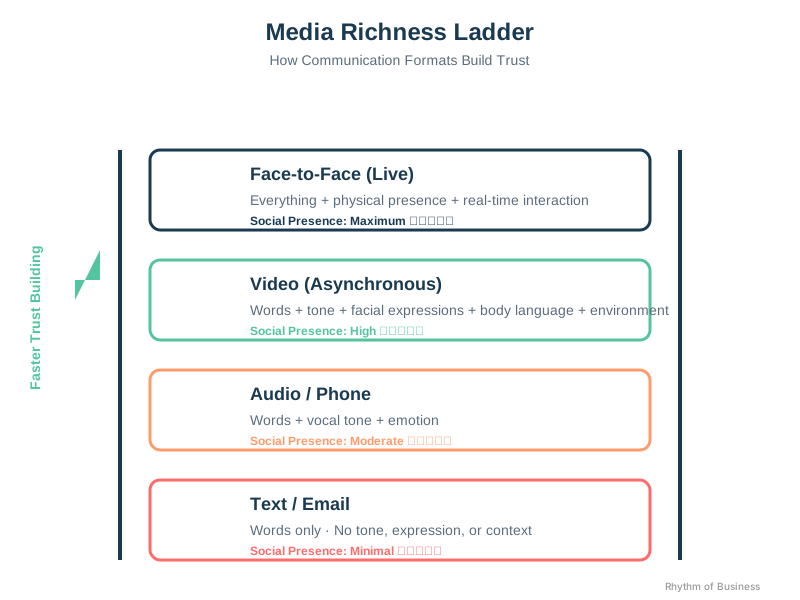
Text-Only Groups (Lowest Richness):
- Transmits: Words only
- Missing: Tone, facial expressions, body language, personality
- Social presence: Minimal
- Trust building: Extremely slow
Phone/Audio (Medium Richness):
- Transmits: Words + vocal tone + emotion
- Missing: Facial expressions, body language, visual context
- Social presence: Moderate
- Trust building: Faster than text
Video (High Richness):
- Transmits: Words + tone + facial expressions + body language + environment
- Missing: Only physical presence
- Social presence: High
- Trust building: Fast
Face-to-Face (Highest Richness):
- Transmits: Everything + real-time interaction
- Social presence: Maximum
- Trust building: Fastest
Here’s why this matters for online networking: Facebook groups and WhatsApp chats are stuck at the bottom of the ladder. They’re fundamentally limited by being text-only.
You can post more. You can comment more. You can add reactions and GIFs. But you’re still just transmitting words on a screen. Your brain can’t build trust from words alone it needs the human cues that evolved over millions of years of face-to-face interaction.
“Text-only groups create activity. Video creates connection. One keeps you busy. The other builds relationships.”
What Video Conveys That Facebook Groups Can’t
Let’s get specific. What exactly are people getting from video that they miss when you post in an online group?
1. Facial Expressions (Trustworthiness Cues)
Your smile tells people you’re warm. Your eye contact (looking at the camera) signals sincerity. The micro-expressions around your eyes show genuine enthusiasm versus polite interest.
A Facebook post can say “Excited to connect!” Video shows whether that’s actually true.

Sarah Martinez
Marketing Consultant
Martinez Marketing Solutions
Vancouver, BC
"I was in three LinkedIn groups and a Facebook networking group. Posted regularly. Got likes, got comments but never got referrals. The first week I switched to video networking, someone who 'knew' me from those groups said 'Now I finally feel like I actually know you.' Same business. Same expertise. But video made me real."
Fictional character for illustrative purposes
2. Tone of Voice (Emotional Connection)
Written words are flat. “I’d love to connect” could mean anything genuine enthusiasm, polite obligation, or passive-aggressive networking.
But when someone hears your voice, they know. Your tone carries confidence, empathy, excitement, authenticity. You can’t fake vocal warmth.
3. Eye Contact (Intimacy Signal)
When you look at the camera while recording a video, viewers experience it as eye contact. Their brain processes it the same way it would if you were looking directly at them across a table.
This creates a neurological intimacy response the feeling that you’re talking to them, not at them.
Email can never do this. There’s no eye contact in Times New Roman.
4. Body Language (Personality Comes Through)
Your gestures, posture, and energy level communicate confidence, openness, and competence. People make snap judgments about whether you’re someone they want to work with and body language drives 55% of that decision.
An email that says “I’m confident we could collaborate well” is just words. A video where you lean forward slightly, smile naturally, and gesture with open hands? That’s evidence.
5. Environment (Context Beyond Words)
Your background tells a story. Home office? You value flexibility. Tidy bookshelf? You’re organized. Plants on the desk? You pay attention to details.
These small visual cues give people context about who you are beyond your professional title. They humanize you.

Tom Marino
Accountant (CPA)
Marino & Associates Accounting
Coquitlam, BC
Spent months writing thoughtful LinkedIn posts and Facebook comments. Got likes but zero clients. Switched to video for one month same content, just on camera. Three new clients immediately. Video showed he actually knew what he was talking about. Text just looked like everyone else.
Fictional character for illustrative purposes
Tom Marino, Coquitlam-based CPA (fictional character for illustration):
“I used to think online networking meant LinkedIn posts and Facebook groups. I’d write thoughtful comments, share articles, answer questions. People would ’like’ my stuff, but nobody was actually calling me. Then I tried video networking for one month. Same content just on video instead of typed out. Three new clients. Same expertise. Same availability. But video let people see I actually knew what I was talking about. Text just looked like everyone else giving generic advice.”
“Text posts show what you know. Video shows who you are. One informs. The other builds trust.”
When Video Works (And When Text Groups Have Their Place)
Not every communication belongs on video. Text-based groups serve a purpose. But if you’re trying to build actual business relationships the kind that generate referrals video creates a completely different level of connection.
Use Video for Building Real Relationships:
Introducing Yourself to New Connections
In a Facebook group, you’re one of 500 introductions people scroll past. On video, you’re the person they actually remember.
Weekly Networking Updates
Text updates in WhatsApp groups get ignored. Video updates get watched because people are curious about the human behind the words.
Building Trust Over Time
12 weeks of consistent video posts creates the same trust as 12 in-person meetings. Text groups? You could post for 12 months and still feel like a stranger.
Positioning as an Industry Expert
When you explain insights via video, people see your expertise through your confidence, tone, and depth. Text posts just look like everyone else’s advice.
Referral Requests That Feel Personal
Posting “Anyone know a good accountant?” in a group gets generic responses. Asking on video where people know your voice, your face, your story gets actual introductions.
When Text Groups Still Work
Video is powerful. But online groups aren’t useless.
Quick Logistical Updates
“Meeting moved to 3pm” doesn’t need social presence. Text works fine.
Sharing Resources and Links
Articles, tools, templates text-based sharing is efficient for information transfer.
Large-Scale Announcements
Broadcast messages to hundreds of people work better as text (people can skim and decide if it’s relevant).
Asynchronous Q&A
Sometimes you just need a quick answer to a technical question. Text forums excel here.
Building Initial Awareness
Text groups can introduce you to potential connections. But to turn those connections into relationships? You need video.
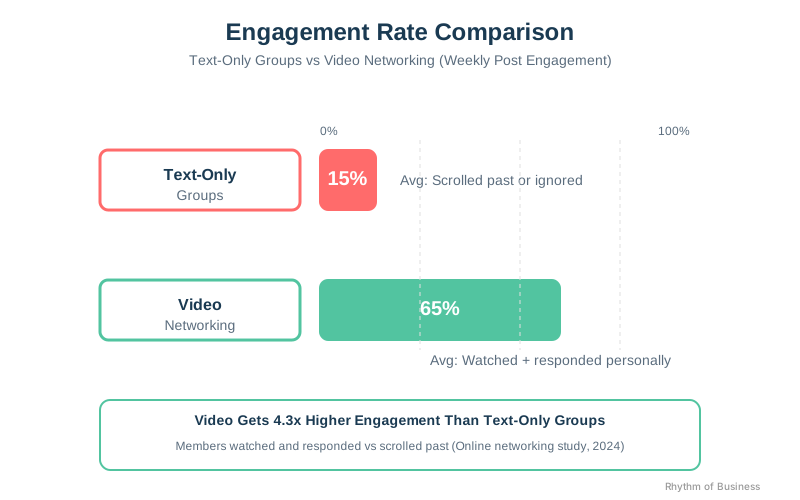
“High-richness media doesn’t just get faster responses it gets better relationships. Video converts strangers into trusted connections. Text groups convert strangers into… people who scroll past your posts.”
Ready to Network Where Video Creates Real Presence?
We built Rhythm of Business because we were tired too. Tired of posting in crowded Facebook groups and WhatsApp chats where nobody actually knew us.
We understand what it’s like to write thoughtful posts that get scrolled past. To request referrals and get polite responses but no actual help. To feel invisible in groups of hundreds.
Here’s what we learned: Text-only groups can’t build the relationships you need. Not because you’re doing it wrong because the medium itself is fundamentally limited.
So we created a different approach:
The Problem We Solve:
- Text-only groups lack social presence (no facial expressions, tone, or body language)
- Massive group sizes mean you’re competing for attention, not building relationships
- Open networks create hesitation (you can’t freely refer competitors)
Our Solution (The Plan):
Step 1: Get Matched with Your Small Video Group
- 8-10 local business owners (not 500 strangers scrolling past your posts)
- One industry per local area (protected territory so you can refer freely)
- Behavioral matching (you network with people who reciprocate like you do)
Step 2: Share Weekly Video Updates
- 30 seconds to 2 minutes on your schedule (not mandatory group meetings)
- Show your face, share your voice, let people meet the real you
- Video creates social presence that text groups can’t match
Step 3: Build Real Relationships That Generate Referrals
- Watch and respond to groupmates’ videos (asynchronous, fits your life)
- Give referrals when you can, receive them when you need them
- Trust builds through consistent video presence over 12 weeks
No competing for attention in massive groups. No awkward self-promotion posts that get ignored. No wondering if anyone actually read what you wrote.
Just real people building real relationships where video creates the social presence that text-only groups fundamentally lack.
Your Next Step
Discover how Rhythm of Business creates video presence that text-only groups can't match.
See How It WorksFind Your Group
Get matched with local business owners who value real connection over busy group chats.
Get Started$69 CAD/month
no charge until matched · cancel anytime
Related Reading
- The Science of Trust: Why 12 Weeks of Video Builds Deeper Bonds Than 12 Months of Email
- From Strangers to Trusted Partners: The 12-Week Journey
- Why Authenticity Beats Polish in Business Networking
Research Sources
This article references peer-reviewed research and established communication theory:
Media Richness Theory:
- Daft, R. L., & Lengel, R. H. (1986). “Organizational Information Requirements, Media Richness and Structural Design.” Management Science, 32(5), 554-571.
- Lengel, R. H., & Daft, R. L. (1988). “The Selection of Communication Media as an Executive Skill.” Academy of Management Executive, 2(3), 225-232.
Social Presence Theory:
- Short, J., Williams, E., & Christie, B. (1976). The Social Psychology of Telecommunications. London: John Wiley & Sons.
- Gunawardena, C. N. (1995). “Social Presence Theory and Implications for Interaction and Collaborative Learning in Computer Conferences.” International Journal of Educational Telecommunications, 1(2), 147-166.
Trust Formation in Mediated Communication:
- Walther, J. B. (1996). “Computer-Mediated Communication: Impersonal, Interpersonal, and Hyperpersonal Interaction.” Communication Research, 23(1), 3-43.
- Jarvenpaa, S. L., & Leidner, D. E. (1999). “Communication and Trust in Global Virtual Teams.” Organization Science, 10(6), 791-815.
Nonverbal Communication Research:
- Mehrabian, A., & Ferris, S. R. (1967). “Inference of Attitudes from Nonverbal Communication in Two Channels.” Journal of Consulting Psychology, 31(3), 248-252.
- Ambady, N., & Rosenthal, R. (1993). “Half a Minute: Predicting Teacher Evaluations from Thin Slices of Nonverbal Behavior and Physical Attractiveness.” Journal of Personality and Social Psychology, 64(3), 431-441.
Video-Mediated Communication:
- Nguyen, D. T., & Canny, J. (2007). “Multiview: Improving Trust in Group Video Conferencing Through Spatial Faithfulness.” Proceedings of CHI 2007, 1465-1474.
- Fullwood, C. (2007). “The Effect of Mediation on Impression Formation: A Comparison of Face-to-Face and Video-Mediated Conditions.” Applied Ergonomics, 38(3), 267-273.