The Science of Trust: Why Weekly Video Updates Build Stronger Business Networks
Networking shouldn’t feel like selling. It should feel like belonging.
But most networking groups get this backward they measure activity instead of reciprocity, attendance instead of trust. You’ve been to the events. Collected the business cards. Sat through the meetings. And referred… almost no one. Because trust doesn’t come from handshakes it comes from seeing someone show up, consistently, when nobody’s watching.
Here’s what science says actually builds referral relationships.
Research from psychology, communication studies, and behavioral science reveals that weekly video updates create genuine business relationships through well-documented mechanisms that have shaped human connection for decades. Not a shortcut. Not a compromise. Just a smarter way to build the trust that generates real referrals.
We built Rhythm of Business on proven science. Let us show you how it works.
What Are Parasocial Relationships? (And Why They’re Not Fake)
Back in 1956, researchers discovered something surprising: TV viewers were forming real emotional bonds with news anchors they’d never met. They called these parasocial relationships one-sided connections that feel genuine despite zero face-to-face interaction.
You’ve experienced this yourself. That podcast host whose voice accompanies your morning commute? The YouTuber whose weekly uploads you look forward to? You’ve never met them, but they don’t feel like strangers they feel like people you actually know.
Here’s the thing: those feelings are real.
A 2023 survey found that 51% of Americans have experienced parasocial relationships feeling connected to someone they follow online but have never met. Over one-third report feeling genuinely “close” to specific creators despite zero face-to-face interaction.
What makes this powerful for business networking isn’t that these relationships are fake or shallow. It’s that your brain processes them as real connections. Familiarity is familiarity, whether it comes from weekly coffee meetings or weekly video updates. Trust is trust.
How Your Brain Builds Business Trust Through Video
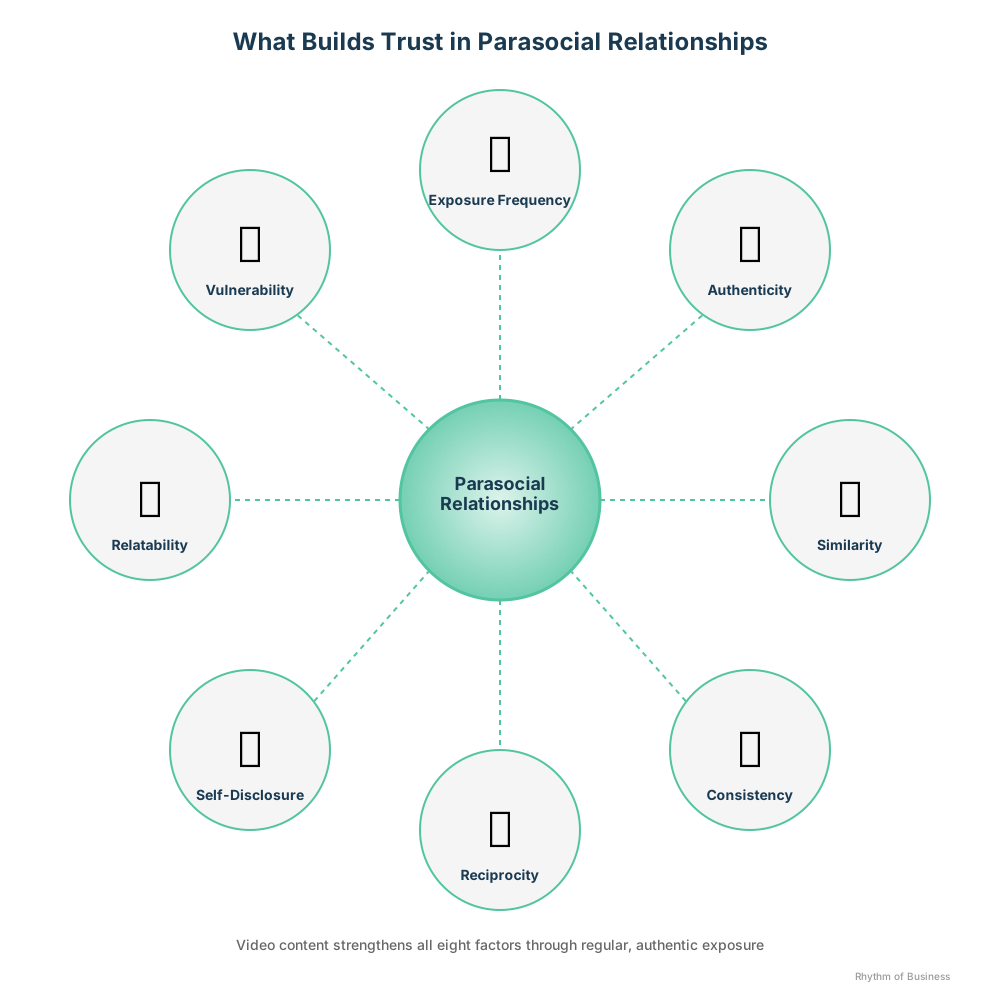
When business owners post weekly video updates, five psychological mechanisms kick in to build real trust:
1. Frequent Exposure
You’re not just a name on a business card. After 12 weeks of video updates, you’re a recurring face, voice, and personality showing up consistently in members’ feeds.
2. Direct Address
When someone records a video looking at their camera, they’re looking at you. Your brain registers that eye contact even through a screen as personal connection.
3. Authentic Self-Disclosure
People share real wins, real struggles, and real lessons learned. No scripts. No heavy editing. Your brain recognizes genuine honesty, and honesty builds trust faster than polish ever could.
4. Shared Business Reality
“They face the same challenges I do.” When you watch another entrepreneur discuss cash flow struggles or difficult client conversations, you recognize your own experience. Similarity breeds connection. Connection breeds trust.
5. Emotional Investment Over Time
After weeks of consistent updates, you start looking forward to specific members’ videos. “I wonder how Sarah’s product launch went.” That anticipation signals real relationship formation you’re emotionally invested in their success.
Here’s what this means in practice: the same psychological mechanisms that make you feel connected to podcast hosts work peer-to-peer in business networks. When 20 entrepreneurs post weekly videos, everyone forms real connections with everyone else. Trust at scale.
Your Brain’s Familiarity Shortcut
In the 1960s, psychologist Robert Zajonc discovered something counterintuitive: just seeing something repeatedly without any positive interaction makes you like it more.
He called this the mere exposure effect. Show people random shapes or unfamiliar faces multiple times, and they’ll rate them as more pleasant and trustworthy. No explanation needed. Just exposure.
Why? Our brains follow a simple rule: familiar equals safe. In evolutionary terms, this made sense. The threats that killed your ancestors were usually novel the unfamiliar predator, the stranger from outside the tribe. If something showed up repeatedly without causing harm, it probably wasn’t dangerous.
This cognitive shortcut shapes everything from why you start liking songs after hearing them on repeat to why Coca-Cola still advertises despite universal brand recognition.
For business networking? It’s a game-changer.
Why Video Works Better Than Text or Audio
Text familiarity is weak. You might recognize someone’s name after a dozen emails, but there’s no emotional weight. Audio is better voice creates stronger memories than text alone.
But video? Video engages your brain’s facial recognition, voice processing, body language reading, and emotional response systems all at once. When you watch someone’s weekly update, your brain creates a rich, multisensory memory of that person.
After 12 weeks, you don’t just recognize their name you know their face, voice, mannerisms, laugh, and communication style. Your brain has cataloged hundreds of tiny details that add up to real familiarity.
And familiarity gets mistaken for trust. Not manipulation just how human connection evolved. We trust people we encounter repeatedly without negative experiences. Weekly video creates that repetition across your entire network.
Why Video Beats Text and Audio for Authenticity
Not all communication formats build trust equally. The medium shapes the message and some media convey authenticity far better than others.
Text is cold. Email exchanges feel transactional. LinkedIn messages lack personality. Text can’t convey tone, warmth, or genuine enthusiasm. A typo gets misread as carelessness. A short response feels curt. Text communication requires constant interpretation, and interpretation creates uncertainty. Uncertainty blocks trust.
Audio is warmer, but incomplete. Podcasts and voice messages capture tone, pacing, and emotion. You can hear passion or frustration. But you’re still missing half the picture literally. Without facial expressions, you can’t read micro-expressions, eye contact, or body language. Audio builds some familiarity, but it’s one-dimensional.
Video reveals everything. Face, voice, environment, body language, energy. When someone records a weekly video update from their office, you see the bookshelves behind them, the coffee mug on their desk, the way they gesture when excited about a new project. These details create visual transparency the sense that someone isn’t hiding, editing, or performing.
The Pratfall Effect: Imperfection Builds Credibility
Here’s the counterintuitive part: minor imperfections in video actually increase trust.
In 1966, psychologist Elliot Aronson discovered the pratfall effect: competent people who make small mistakes are rated as more likable than those who appear flawless. The stumble humanizes them. Perfection creates distance. Authenticity creates connection.
When a business owner records a weekly video update and their dog barks in the background, or they briefly lose their train of thought, or the lighting isn’t studio-quality viewers don’t think “unprofessional.” They think “real.”
Compare this to traditional networking pitches: scripted, rehearsed, polished to a shine. Everyone sounds like a marketing brochure. But in asynchronous video? You get the real person casual competence, genuine stories, unscripted moments. This signals trustworthiness more powerfully than any elevator pitch.
Social Presence: The “Real People” Feeling
Communication researchers use the term social presence to describe how much a medium makes you feel like you’re interacting with a real person rather than an abstraction.
- Text = low social presence (feels like reading)
- Audio = medium social presence (feels like listening)
- Video = high social presence (feels like being in the room)
When you watch someone’s video, your brain activates the same systems it uses for face-to-face interaction. Mirror neurons fire. Emotional contagion occurs if they smile, you’re more likely to smile. If they speak with enthusiasm, you feel their energy.
This isn’t theater. It’s neurologically real social interaction, even though it’s asynchronous and one-way. Your brain treats it as person-to-person connection, not media consumption.
For business networking, this transforms abstract names on a membership roster into real people you feel like you know.
The Research: How Video Compares to Other Communication Formats
So where does one-way video actually rank in trust-building compared to live interaction?
A 2023 study published in Philosophical Transactions of the Royal Society B (Diana et al.) provides the most rigorous answer we have. Researchers designed trust games comparing four conditions:
- Face-to-face interaction
- Live video calls (synchronous, two-way)
- Pre-recorded video (asynchronous, one-way)
- Text-only communication
The findings:
Face-to-face and live video calls produced virtually identical trust levels. Participants showed the same behavioral mimicry, trust gestures, and willingness to cooperate whether meeting in person or on a live video call. The format difference didn’t matter real-time visual communication builds maximum trust.
Pre-recorded video performed “significantly lower” than live interaction but substantially higher than text-only. Trust remained high just not quite at the peak level of real-time formats.
Text-only communication showed the steepest drop-off, creating far less trust than any visual format.
Here’s what this means in practice:
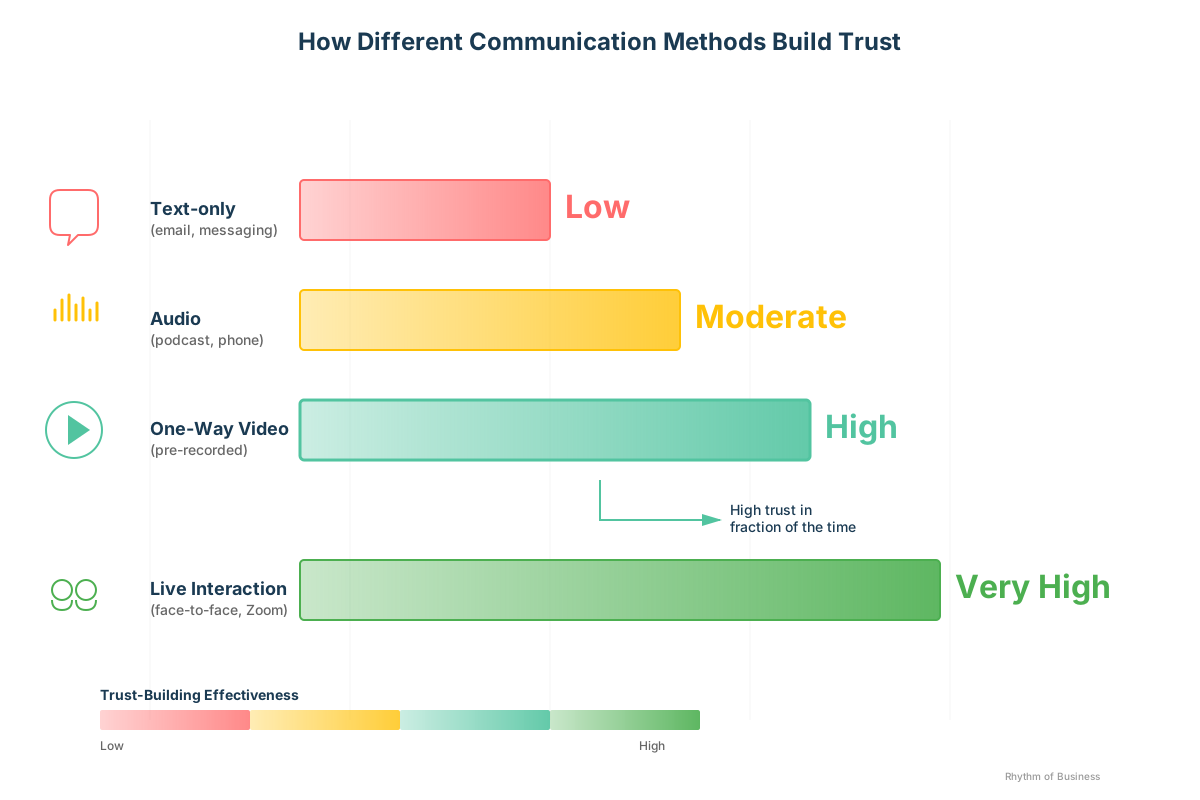
| Communication Format | Trust Level | Key Strengths | Limitations |
|---|---|---|---|
| Face-to-Face | Highest | Full nonverbal cues, real-time reciprocity, behavioral synchrony | Time-intensive, geography-limited, scheduling conflicts |
| Live Video | Highest | Matches face-to-face trust, flexible location | Still requires synchronous time, limited scalability |
| Pre-Recorded Video | High | Strong visual presence, authenticity cues, flexible viewing | No immediate back-and-forth, slightly lower than live |
| Audio Only | Moderate | Captures tone and emotion | Missing visual cues, harder to remember people |
| Text Only | Low | Convenient, asynchronous | Easily misinterpreted, impersonal, low social presence |
The Royal Society researchers noted that pre-recorded video’s trust reduction came from lack of real-time reciprocity viewers can’t ask questions, get immediate responses, or experience synchronized behavioral mimicry. But the trust loss was minimal compared to dropping to text-only formats.
The Efficiency Trade-Off
Here’s the crucial insight: asynchronous video achieves substantial trust in a fraction of the time required for live networking.
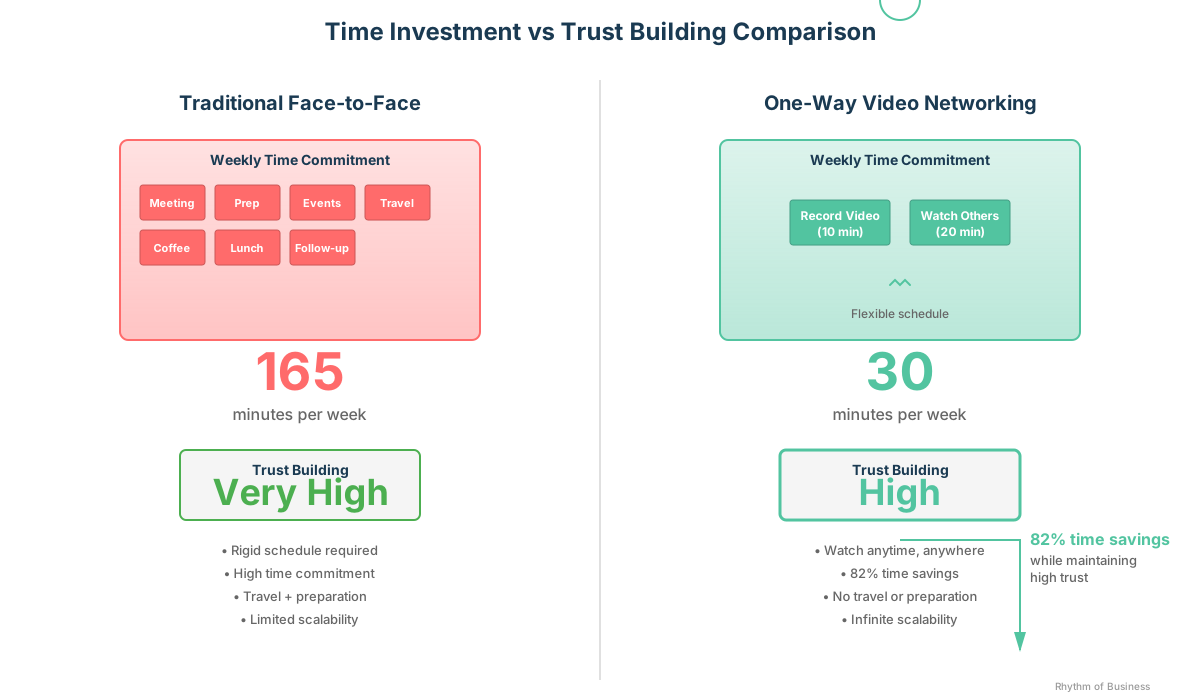
Traditional networking (BNI-style weekly meetings):
- Meeting time: 90 minutes
- Travel: 60 minutes round-trip
- Prep: 15 minutes
- Total: 165 minutes/week = 138 hours/year
Asynchronous video networking (Rhythm of Business):
- Record weekly update: 10 minutes
- Watch member videos: 20 minutes
- Total: 30 minutes/week = 26 hours/year
The time savings: 112 hours per year 14 full workdays reclaimed. And you still build high trust through weekly visual exposure, authentic self-disclosure, and parasocial familiarity.
For busy entrepreneurs, this isn’t a compromise. It’s an optimization: maximum trust per minute invested.
The Power of Repeated Video Over Time
One video doesn’t build trust. But twelve videos? Twenty-four videos? Fifty-two weeks of consistent presence?
That’s when parasocial relationships become powerful.
Consistency Signals Reliability
Showing up every week without fail, for months demonstrates commitment. Anyone can send one impressive video. But consistent weekly updates over time signal: “I’m serious about this network. I’m reliable. I’m invested in these relationships.”
In trust research, behavioral consistency is one of the strongest predictors of perceived trustworthiness. People trust those who do what they say, repeatedly, over time. Weekly video updates make consistency visible.
Evolving Storylines Create Emotional Investment
After a few months, you’re not watching isolated updates you’re following ongoing narratives.
“Sarah launched her new service three weeks ago how’s it performing?”
“Mike was hiring last month did he find someone?”
“Linda’s client project was hitting roadblocks did she resolve it?”
You become emotionally invested in other members’ success because you’ve watched their journey unfold. When someone finally closes a deal they’ve been working toward for weeks, you feel genuine excitement. When they hit a setback, you empathize because you’ve heard them strategize through challenges.
This emotional investment transforms networking from transactional (who can help me?) to relational (how can we support each other?). And relational networks generate more referrals than transactional ones.
Cumulative Knowledge Reduces Uncertainty
After 12 weeks of weekly videos, you have detailed mental models of every member:
- Their communication style (direct vs diplomatic, data-driven vs storytelling)
- Their expertise areas and recent projects
- Their business challenges and goals
- Their personality, values, and working preferences
- Their network needs and ideal referral profiles
This accumulated knowledge dramatically reduces uncertainty about who to refer, how to approach them, and whether they’ll deliver quality work.
Uncertainty Reduction Theory (Berger & Calabrese, 1975) shows that trust increases as uncertainty decreases. More information about someone equals lower perceived risk. Weekly videos provide that information at scale everyone learns about everyone without scheduling 190 one-on-one coffee meetings.
Mutual Parasocial Relationships
The magic of asynchronous video networking isn’t one-way parasocial bonds (you watching others). It’s mutual parasocial relationships: everyone posts videos, so everyone knows everyone.
This creates network density impossible in traditional formats. A 20-person BNI chapter might have strong relationships between 3-5 close contacts and weak ties with the rest. But a 20-person video networking group where everyone posts weekly? After three months, all 190 possible relationship pairs have meaningful familiarity.
It’s what remote teams experience: “We’ve never met in person, but after a year of video standups, I feel like I’ve worked with them for years.”
Trust But Verify: Converting Familiarity Into Real Business
Here’s what’s critical to understand: parasocial trust is real, but it’s also just the first layer.
Watching someone’s weekly videos builds genuine familiarity and positive feelings. Your brain registers them as trustworthy because of repeated exposure without negative experiences. But that’s cognitive trust the belief that someone is probably competent and reliable.
Full business trust requires affective trust the confidence that comes from actual working relationships, successful referrals, and proven follow-through.
Asynchronous video gets you to cognitive trust efficiently. Converting that to affective trust requires action:
- Sending referrals and seeing quality delivery
- Messaging members for advice and getting helpful responses
- Collaborating on projects and experiencing their work ethic
- Meeting in person (if local) to deepen connection
Think of parasocial familiarity as lowering the barrier to engagement. Without video, reaching out to a fellow member feels like cold contact uncertain, risky, awkward. With three months of video familiarity, messaging someone feels like continuing an existing conversation. You already know their voice, their style, their recent projects. Connection is easy.
This is how modern business relationships form: digital familiarity creates the foundation, real interactions build the structure.
And that’s exactly what Rhythm of Business facilitates video updates make everyone familiar, then the platform encourages follow-up through messaging, asks, offers, and optional local meetups. Parasocial becomes truly social through action.
The Science-Backed Future of Business Networking
For decades, business networking followed a simple premise: trust requires time spent together, preferably face-to-face, on a rigid schedule.
But behavioral science reveals a more efficient path.
Weekly video updates leverage three proven psychological mechanisms:
- Parasocial relationships create genuine one-sided familiarity (51% of Americans have experienced this connection)
- Mere exposure effect makes repeated visibility build liking and trust automatically
- Visual authenticity through video conveys personality, warmth, and credibility far better than text
Research from the Royal Society confirms that pre-recorded video builds substantial trust significantly higher than text or audio, approaching the effectiveness of live interaction. The slight gap compared to real-time formats is easily justified by 82% time savings (30 minutes/week vs 165 minutes/week).
After 12-24 weeks of consistent video updates, you don’t have weak connections you have mutual parasocial familiarity across an entire network. Everyone knows everyone’s face, voice, personality, and story. Trust exists before the first business interaction even occurs.
This isn’t networking theater. It’s not a shortcut or compromise. It’s applying behavioral science to achieve trust at scale genuine relationships built through authentic weekly presence, multiplied across 20+ members, sustained over months and years.
In 2025’s digital-first business world, seeing truly is believing. And weekly video helps us see each other as the trustworthy partners we actually are.
Learn More About Us
Discover how we built Rhythm of Business to solve the networking time waste problem.
Find Your Group
One spot per industry, per group. First come, first served.
$69 CAD invoiced monthly
no charge until matched
Sources cited:
- Horton, D., & Wohl, R. R. (1956). Mass communication and para-social interaction. Psychiatry, 19(3), 215-229.
- Thriveworks (2023). National Survey on Parasocial Relationships.
- Zajonc, R. B. (1968). Attitudinal effects of mere exposure. Journal of Personality and Social Psychology, 9(2), 1-27.
- Diana, B., et al. (2023). Trust and mimicry in face-to-face and video-mediated communication. Philosophical Transactions of the Royal Society B, 378(1875).
- Aronson, E., Willerman, B., & Floyd, J. (1966). The effect of a pratfall on increasing interpersonal attractiveness. Psychonomic Science, 4(6), 227-228.
- Berger, C. R., & Calabrese, R. J. (1975). Some explorations in initial interaction and beyond. Human Communication Research, 1(2), 99-112.